
Digital Parenting Anxiety in 2025: Why We Feel Watched, Judged and Left Behind

Updated: Jan 9
You are not just worried about technology, you are worried about something more slippery, more invisible and more unsettling.

You are worried about being watched, recorded, misread or misjudged by systems you never asked for. You are worried that the digital world knows more about your child than you do, and that half of it is being stored somewhere you will never see, probably in the same place your kid’s missing school hat ended up.
This is not screen time anxiety, this is digital paranoia; a low, constant hum whispering, ‘Who is listening, what is being stored, and how on earth would I know?’ It is reasonable in parts, overblown in others and completely human in every direction.
Let’s pull it apart with a cup of tea and a tiny splash of honesty.
The New Parenting Fear
“My child is being fed into systems I cannot see”
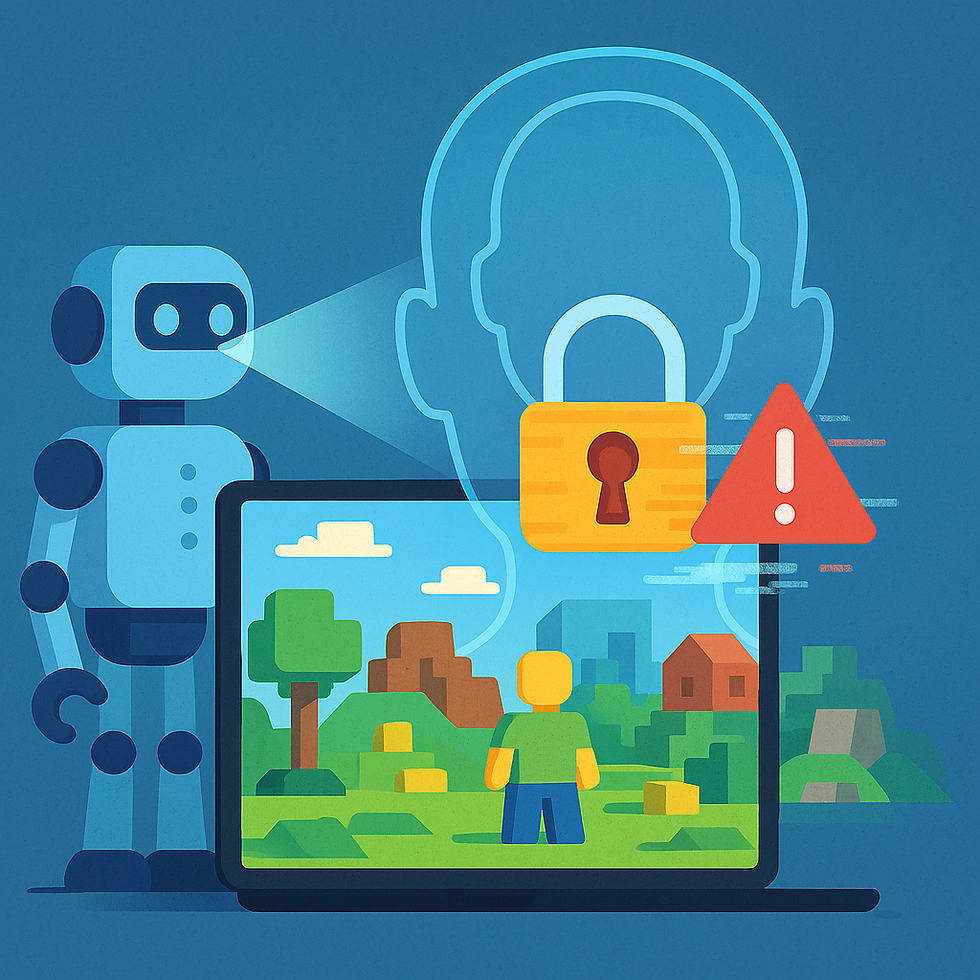
Parents do not fear devices, we fear invisible systems.
You might feel like your child (or yourself) is being recorded by AI tools without consent, analysed by algorithms that get things wrong, tracked by data points you never opted into, judged by automated systems you do not understand and exposed to digital environments you cannot supervise. When you see headlines about AI tools recording meetings without consent, voice and image data being stored indefinitely or predictive modelling making assumptions about children, your stomach drops and your brain mutters, "Brilliant, another thing I cannot control".
Research backs the fear. Machines have labelled children as aggressive because of a frown, transcription tools have confidently misquoted teenagers (or adults) and automated systems have flagged kids as risks based on nothing but vibes.
A machine gets it wrong and no human notices - that is the nightmare.
The Distortion Problem
“What if the digital version of my child is nothing like my actual child?”
We are the first generation to raise a child who exists multiple times; a real version you can cuddle, feed and remind to brush their teeth, and a digital version made of keystrokes, photos, metadata and algorithmic guesswork. That second version, or sometimes several versions, is persistent, replicable and immortal, able to wander the internet with more freedom than most adults.
You fear this digital copy might outlive the real one and shape assumptions long after the moment has passed. Research confirms this concern. Photos of Australian children have been scraped into global datasets, AI models have reproduced private text from training data and organisations cannot explain where collected data goes or how long it stays.
The Silence Problem
“Everything is happening behind the screen”
You cannot see what the algorithm is doing, you cannot see how the data flows and you cannot see what invisible decisions are being made. It creates a very specific kind of parental paranoia, a sense that something could be happening right now and you would have no idea.
You might have discovered:
a video call was transcribed without your awareness
a smart speaker stored something it should not have
your child’s photo appearing in a training dataset
an app quietly logging more than expected.
Each moment reinforces the same thought: 'I do not know what I do not know.'
Digital anxiety thrives in the gaps.
When Reasonable Concern Turns Into Digital Paranoia
Digital paranoia is not a diagnosis; it is what happens when rapid technological change collides with limited transparency and parenting guilt.
Deepfake headlines, voice assistant scandals, increased AI usage and a national social media ban pile up until every notification feels loaded. The shift moves you from "technology is complicated" to "technology is quietly plotting against us," and that slow slide is what researchers call digital paranoia. It grows in the blank spaces where imagination fills in the worst case scenario.
The Top Five Digital Paranoias of 2025
1. “My child is being watched”
Not by a villain, by passive data capture, location settings and microphones pretending to sleep.
2. “Something will be stored that cannot be undone”
A misquoted transcript, a flagged behaviour, a scraped photo or a leaked deepfake. Machines create permanence, and that is the fear.
3. “The algorithm will misinterpret them/me”
You worry they will be judged unfairly or punished for something generated by a machine, with no clear understanding of who checks these systems or whether anyone does at all.
4. “I can't keep up”
Not knowing creates shame. Shame creates panic. Panic creates stories that snowball far beyond the facts.
5. “The world changed and no one told me how to parent in it”
You woke up in a new world with no map and no instructions.
The Other Side of the Story
For every scary headline about rogue AI, there is decades of research showing that panic causes more harm than the technology itself.
The biggest predictors of digital wellbeing are the same ones that guide face-to-face wellbeing. Connection, boundaries, warmth, curiosity and emotional regulation matter more than which app is on the screen. Digital paranoia tells you that you are behind, failing and unsafe. Digital literacy reminds you that you can learn, you can lead and you can guide without fearing your child’s world.
What Actually Helps
Digital anxiety settles when you feel informed, supported, involved and empowered.
What helps most:
Clear explanations about how tools work.
Consent processes that actually mean something.
Co-learning, so you build skills alongside your child.
Shared values that guide choices across all devices.
Conversations that focus on connection rather than surveillance.
A mindset that treats AI as a context to navigate, not a monster to fear.
You do not need to control the entire digital world. You only need to stay connected to your child in it.
TRY THIS
Three conversations that can ease the mental load and bring clarity back into the room.
These are not complicated or expert level, they are the kind of conversations you can have while chopping carrots, packing tomorrow’s lunch or hiding in the pantry because someone yelled “Mum” for the seventh time.
1. With Your Child
Ask: “What are you and your friends using right now that I might not know about?”
Let them talk. Let them teach you. Staying curious shifts the tone, and kids are often more open when they feel they are explaining something rather than defending it.
2. With Your Co-Parent
Ask: “What are we actually worried about here? Is this based on something real, or are we guessing the worst?”
Naming the fear out loud usually takes some pressure out of your chest, and it helps both of you see whether the concern is specific or broad.
3. With Yourself
Ask: “What exactly is making me uneasy? Which part feels out of my control?”
Naming what sits underneath the anxiety often brings a moment of clarity, and that clarity gives you something real to work with. Sometimes the next step is information. Sometimes it is a simple boundary. Sometimes it is permission to not have all the answers today.
Digital confidence grows slowly, conversation by conversation and moment by moment. Starting small is enough.
A Final Word for The Digitally Anxious
You are not imagining the pace, it is fast. You are not imagining the gaps, they are real. You are not imagining the risks, they exist, and fear grows where information stops. Your power sits in the middle space; curiosity, connection, co-learning and conversation steady the ground. The moment you shift from “I can't control this” to “I can understand this,” everything softens.
You can guide your child through this world, and you can stay close. That is enough, and it carries more weight than any algorithm ever will.
You've got this.

Comments